
History of Syclones and Typhoons
If you are a devout truck enthusiast or even a casual fan, you find something special in the genre. To those of us who are “truck people,” every truck is special, but some stand out more than others do.
The evolution of trucks, from steam wagons in the 1770s, to the internal combustion trucks of Karl Benz in 1895 and Gottlieb Daimler in 1896 has evolved into today’s diesel and turbo trucks and electric and hybrid models. The genre of truck may have started with pick-ups, 18-wheelers, tow trucks, and three-quarter-ton representations, but the niche has grown to include, vans, compact trucks, sport trucks, and the most popular derivation outside full-sized trucks in today’s marketplace, the sports-utility-vehicle, or SUV. In fact, as a group, SUVs are currently the world's largest automotive segment, accounting for nearly 50 percent of the world's passenger car market in 2020.
During the late 1990s and early 2000s, the popularity of SUVs greatly increased, and along the way, sports-ute stars have come and gone. During that time, another genre has gained popularity, the sport truck.
A sport truck is for the “more power” crowd. A sport truck is any truck that has been modified for enhanced appearance and/or performance.
Today, the power, the cosmetics and accouterments are limited only by imagination, but back in the day, a sport truck and an SUV stand out. Limiting the scope to just these two, a turbocharged SUV and its sibling, a sport truck, attacked the market. These pioneers brought performance, big horsepower, and sportscar-killing performance to the truck and SUV niche before the uptweak became commonplace. These two vehicles were GMC’s Syclone compact pickup and Typhoon SUV, revered and followed today by numerous “SyTy” forums.
GMC SYCLONE
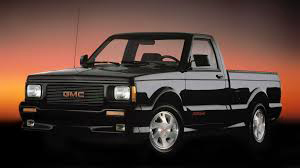
The GMC Syclone was a high-performance version of the GMC Sonoma pickup truck, with 2,998 units produced in 1991 and ’92 by GMC along with Production Automotive Services (PAS). Following the Syclone, the 1992 GMC Sonoma GT truck was offered as a sport package with the looks of a Syclone but without the price and performance of its turbocharged predecessor.
Legend has it that Syclone with an "S” was an homage to the “S-10” or “Sonoma”, but Mercury had already produced the Cyclone (with a “C”) from 1964-’71 and GMC did not want to copy that name representation.
Measuring 180.5 inches long, 68.2 inches wide and 60.0 inches high on a 108.3-inch wheelbase, Syclones powered up with a 280hp 4.3-liter turbo V-6. Weighing in at 3,599 lbs., and mated to a 4-speed 4L60 automatic transmission, Syclones were timed in a 4.3-second zero-to-60mph sprint and a 13.4-second quarter-mile.
Engine modifications included lower-compression pistons, special intake and exhaust manifolds, a multipoint fuel injection system, bigger twin-bore throttle body from Corvette's 5.7-liter small-block, and a Mitsubishi TD06-17C turbocharger with a Garrett water-to-air inter-cooler.
Syclone was meant for the street. Its cab carried a warning: "This vehicle is not intended for off-road use. The reduced height of this vehicle will not allow it to clear obstacles commonly encountered in an off road environment. Off road operation could result in serious damage to chassis and drivetrain.” In addition, it wasn’t meant to haul. Syclone had a 500-pound payload capacity, low for a pick-up, and towing was not recommended by the factory.
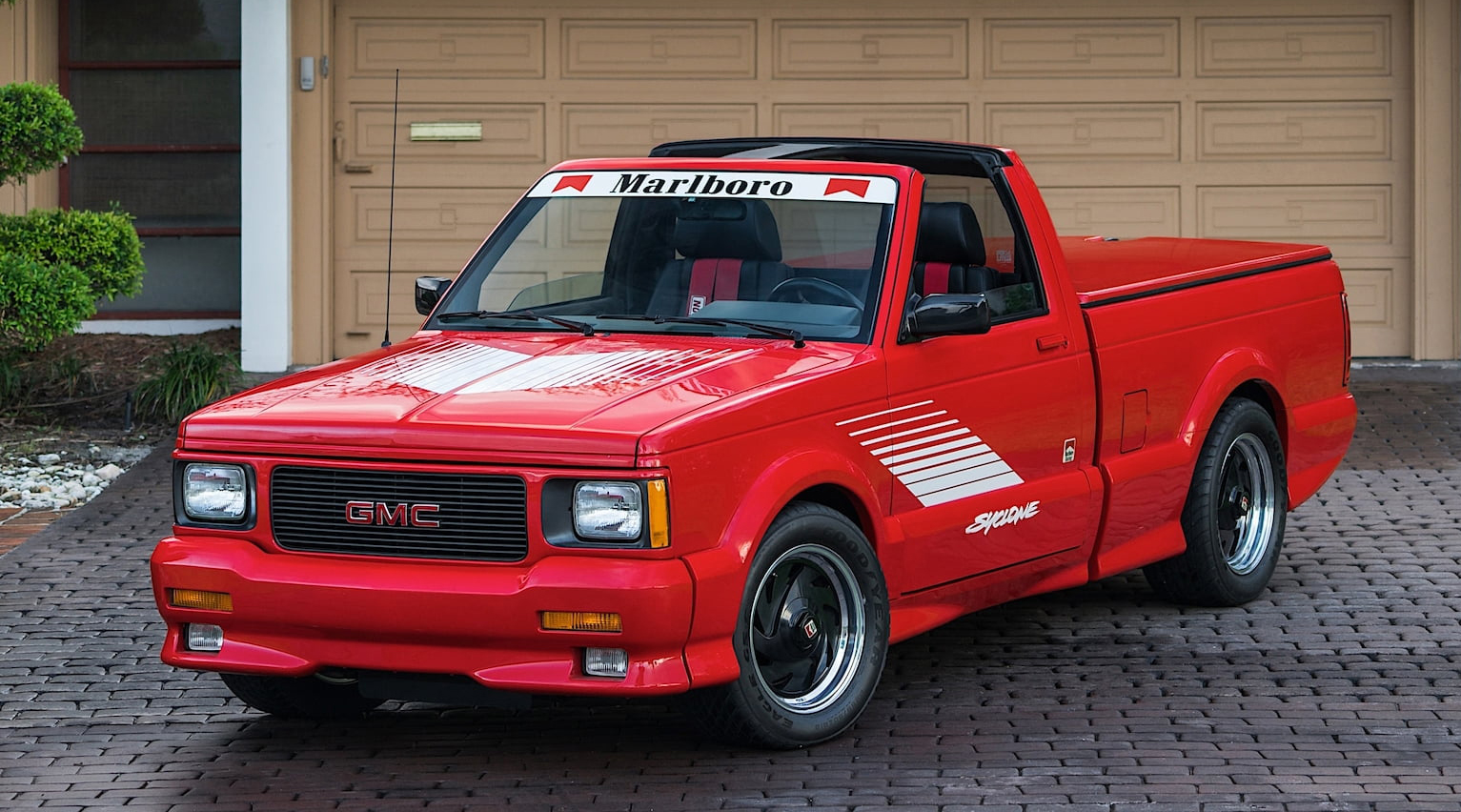 Syclone only came in black, except for a few third-party exceptions: The Red Marlboro Syclones customized by American Sunroof Company, and the Indy Syclone, used at the Indianapolis 500 race in 1992. Although there were three of these unofficial pace cars, only one (the PPG version) got a multi-colored silver, magenta, and aqua paint scheme, while the other two got sticker packages.
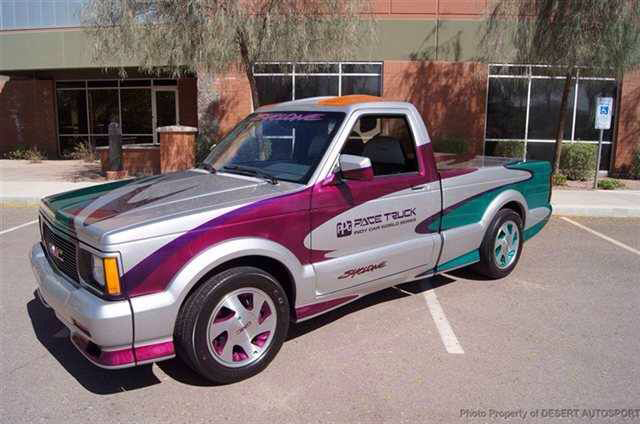
Marlboro Syclones featured Boyd Coddington wheels, Recaro leather seats, a Momo steering wheel, and a targa-style removable roof panel. The Indy had a racing fuel cell, a built-in halon fire suppression system, water-cooled brakes, and color matched leather interior to the exterior paint scheme. The bed had a multi piece tonneau cover that accordion folds with the tailgate to reveal the fuel cell, halon canister mounts and a molded in light bar in the roof.
A GMC ad for the Syclone compared it to a Porsche 911 Carrera 4, with the ad headline: "Think of it as a Porsche 911 that really hauls.”
GMC Typhoon
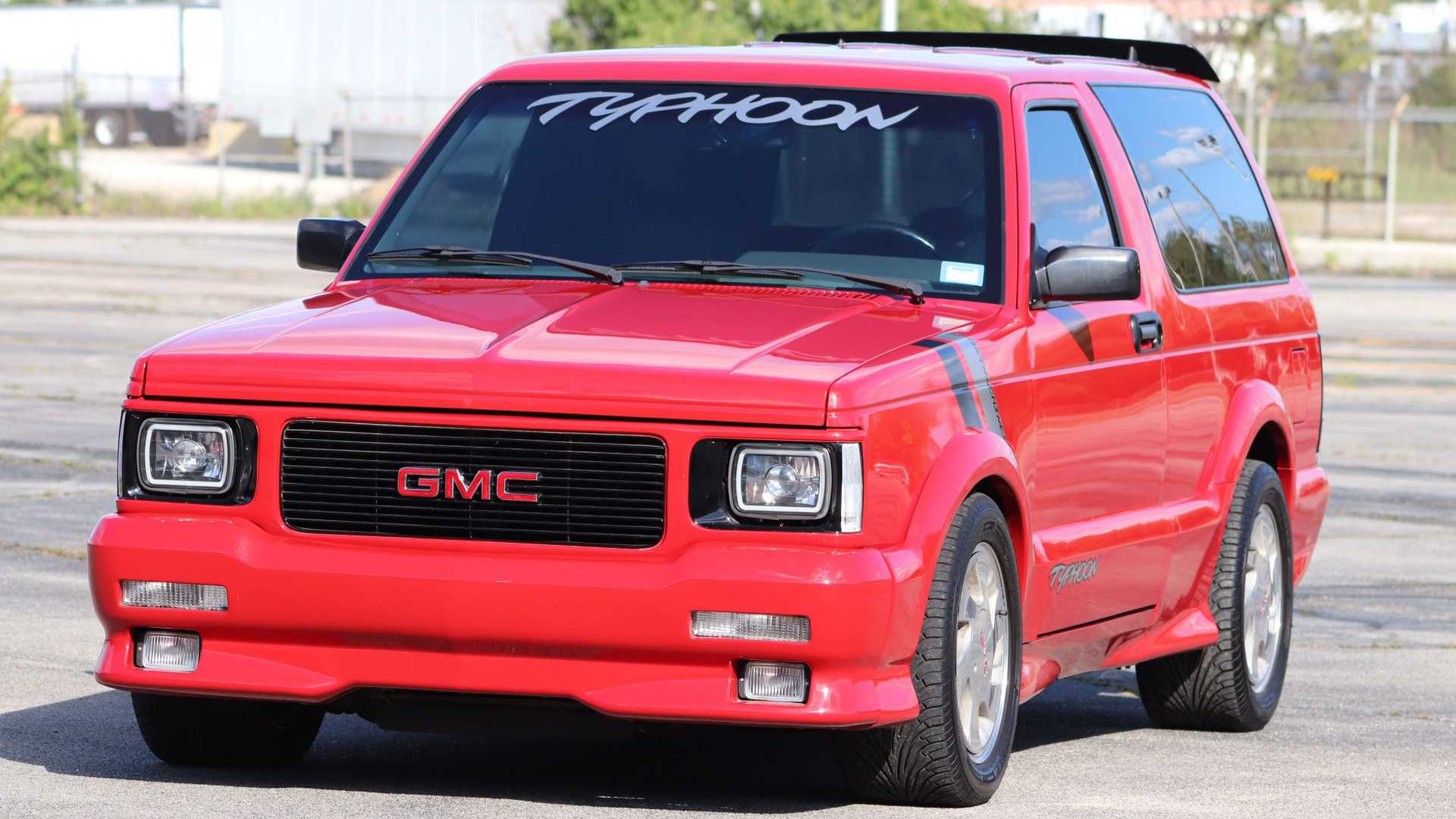 Based on the GMC Jimmy, General Motors produced 4697 Typhoons from 1991-1993. The two-door mid-size SUV was powered by the same modified turbocharged 4.3-liter V-6 that powered the Syclone, although Typhoon’s transfer case was a BorgWarner 4472 – Syclone used a BorgWarner 1372). Like the Sy, the Ty system also produced 280hp and 350 lb-ft. of torque. The Ty had a 100.5-inch wheelbase and measured 170.3 inches long, 68.2 inches wide and 60.0 inches high, weighing in with a curb weight of 3822 lbs. The manufacturer touted a 5.3-second zero-to-60mph dash, and the SUV ran a 14.1-second quarter-mile.
Typhoon paint colors included Forest Green Metallic, Radar Blue, Raspberry Metallic, Frost While, Royal Blue Metallic, Aspen Blue, Bright Teal, Apple Red, Garnet Red, and black, and it was a favorite among celebrities.
Among those big names who owned Typhoons were Clint Eastwood, John F. Kennedy Jr., Bob Seger, and two Miami Dolphins players – Brian Cox and O.J. McDuffie.
You can see Syclones, Typhoons in Building Y this year presented by the SyTy’s at Carlisle club display. In addition, also at Carlisle are all manners of trucks, from the early days to the present, from the antique to the modern and from the iconic to the obscure, at the Carlisle Truck Nationals presented by A&A Auto Stores August 6-8 at the Carlisle, PA Fairgrounds.
> Visit www.CarlisleEvents.com for more on the automotive hobby.
Mike Blake, former editor of KIT CAR magazine, joined Carlisle Events as senior automotive journalist in 2004. He's been a "car guy" since the 1960s and has been writing professionally for about 30 years. </I>
Book with a preferred Hotel

Book online or call (800) 216-1876



-(1).png?sfvrsn=f108493a_2 "Hemmings")




Leave a commentOrder by
Newest on top Oldest on top